22 Maret 2011

What is a Superfood Really?

It might seem like a silly question really. But what is a super food?

When I think of a superfood, I immediately think of blueberries. I think of things that are dark green or deep purple, foods that go beyond basic nutrition, foods that house more nutrients per cubic millimeter than others. I always thought they are usually fruits and vegetables, but more often fruits: blueberries, acai berries, spirulina and chlorella. Many of the superfoods are things I already eat, but some are not.

So imagine my surprise the other day when I saw this as I rode home on my uptown A train.


Do you see that little sentence at the very bottom? It says “With over 30 vitamins and nutrients, peanuts are a Superfood”. Well I am no hater of peanuts. In fact I rather like their taste. But ever since I read about aflatoxins and lectins, I haven’t reached for them. But the truth is, I never ate them that often. The aflatoxin thing just sealed the deal. I much prefer almonds and cashews. But something about this statement pissed me. It seemed so obviously marketing.

Now I don’t doubt that peanuts contain 30 vitamins and nutrients, but I have also read enough that I might hesitate to compare peanuts to blueberries if I was the one writing the article. So I asked myself, what is a superfood? My conclusions were kind of interesting.

When I first Googled ‘superfoods’ and what is a superfood’ I turned up hundreds of thousands of articles trying to sell me chlorella caps and Odwalla juice. The individual cites threw the term around loosely, mostly in high praise of whatever they were selling. Then I Googled ‘list of superfoods’ and I got a couple of interesting returns.

First I got Web MD articles and the like giving me 10 or 12 superfoods that my diet can’t be without. Stuff like Salmon and Spinach and there they were blueberries. But a better cite came next. Off a site called http://www.superfoodinfos.net/ I got a long article listing out foods and explaining it. The article listed out many many different foods from acai berries to carrots and cantaloupe to garlic and green beans to prunes and pumpkins all the way to walnuts and wild salmon. Virtually every fruit and vegetable was on this list. This was the longest list I found. But I didn’t look past the first Google page, because I specifically wanted cites with a lot of hits. I wanted to know what the conventional wisdom was.

There is only one animal food on the list, wild salmon. The rest are fruits and veggies and nuts and spices. There are only two nuts on the list—cashews and walnuts. In fact while there was great variance among the different lists I read (some included almonds), NONE of the sites mentioned peanuts as being a superfood.

But what about an official list of superfoods? Well, there isn’t one. I checked. ‘Superfood’ is not a term that is regulated by the USDA. Coca-Cola could put the term on the outside of their sodas with no legal repercussion (If I am wrong, can someone school me in the comments section—thanks!). Though possibly they might call attention to the word and get sued for some kind of civil advertising something.

But that is what makes this peanut case all the more tricky. If Coca-Cola proclaimed their sodas as superfoods, you would probably think less of them, because you didn’t inherently believe it. That would be the kind of marketing that pissed you off enough to tweet about it, or even sue. And that is bad publicity. But when peanuts advertise themselves as superfood, you might think it sounds kind of right. In fact, maybe it takes you off guard a little because you have never heard of peanuts being a superfood. Then you start to think maybe they just got ‘superfood’ status, so that’s why you haven’t heard of it. And peanuts are really high in protein and they are (sometimes) unprocessed, maybe the next time you are at the store you’ll pick some up! After all they are a superfood.


But this advertisement is just playing into the pre-conceived notions that you already have. The advertisement, in my opinion, is aimed at people who already have a favorable opinion of peanuts. The advertisement attempts to make those people go out and take action by buying peanuts. On one hand, claiming that they are a superfood is a bold move when you realize that the word means virtually nothing. And on another hand this is a very subtle ad campaign that plays on some of the hot verbiage in the marketing place. And it is smart for an industry lobby to reach out to those folks who like their products, but haven’t recently bought.

This post today is not out to get you stop buying peanuts. Hell, peanuts are in general pretty good for you. Even my pediatrician laughed at the notion of aflatoxins when I discussed it with her. “Oh yeah, they’ve known about them for years”, she said. Go and buy peanuts if you love them.

The point of this post is to encourage you to become more of a skeptic. This is a good one, a really good one. Never think that you are too smart to withstand marketing. Modern marketing is tricky, and sophisticated. The marketers might not be able to convince you about everything, but I guarantee they have gotten you on at least one thing in the last week. And you didn’t even realize it. So keep reading, keep googling, stay aware and make up your own damn mind.

This post is part of Food Renegade's Fight Back Fridays and Real Food Whole Health's Fresh Bites Friday

Potassium Iodide

Radiation Dosage Chart


Usefulness of Iodine


Potassium Iodide 
pharmaceutical grade, professional product 


300 tablets
$32.00  price includes US shipping only


Please contact us for orders shipping to outside the US

Dulse, Kelp Bladderwrack and related products also available


Welcome Spring!

I'm making an extra post today just to welcome Spring!  Flowers are popping out all over the place, but I wanted to especially recognize our early spring woodies. On my lunchtime walk today I spotted four beautiful trees that are just beginning to bloom in my area north of Atlanta.

Redbud (Cercis canadensis) - how this tree got the name "Redbud" is a mystery to many folks because to most of us the flowers appear to be purple!  But you know they say that colors and smells are subjective so we will just have to accept that someone thought they were red.


Red buckeye (Aesculus pavia) - this is one of my favorite trees and a real success story for my attempts to grow new plants.  Hummingbirds love the flowers, and I'm sure they an important source of nectar for these birds as they return from their winter homes.  The big fat nuts are easy to gather and germinate readily if you can keep them away from squirrels.  I have grown many of these from seed and donated them to the annual plant sales for the Georgia Native Plant Society.


Serviceberry (Amelanchier arborea) - the modest white flowers of Serviceberry are just beginning to appear on wooded roadsides near my house.  Small, tasty berries will form from the blooms, turning first pink and then red/dark purple.  However, the birds love them so much that they usually are eaten before you get to see the final color!  Early settlers used the berries as well.


Flowering Dogwood (Cornus florida) - this tree is a real symbol of the southeastern U.S. states - from Virginia to Georgia, it is a popular landscape tree and a familiar sight in wild areas like state parks.  What people don't usually realize is that there are many other members of the Cornus genus with vastly different looking flowers and berries.  Still, this one blooms first and is more showy than any of its cousins.


And as a bonus, here are the colorful samaras (seeds) of Red maple (Acer rubrum); the blooms are long gone, but I'll bet that many folks see these from a distance and think they are flowers.  They are pretty and colorful enough that I could agree with that!


I hope you are enjoying some of Georgia's beautiful native flowers this week in celebration of the arrival of Spring at last.

21 Maret 2011

The Tale of the Pan-Fried Peanut Butter Cookies

Now kids I want to tell you a little story, The Tale of the Pan-Fried Peanut Butter Cookies.

It all started one evening in March. There once was a good and kind Queen who wanted nothing more than for her children to have fresh nourishing whole foods to eat. The Queen loved her King, but he often times brought the Princes candy to eat that the Queen did not approve of. But the Queen loved her King and decided not to press the issue. One evening the King brought home Reese’s Pieces. The oldest Prince was enchanted. But the Queen was annoyed. The following day the Queen told the Prince that together she would make a healthy(er) version of the peanut buttery treats.

The next Saturday, while the littlest prince napped, the Queen went to her kitchen to make the peanut butter confection. But confectioner’s sugar has been highly processed. So the Queen thought she would try sucanat sugar. The consistency of confectioner’s sugar was the key to fudge and frosting’s texture, and so she thought to put a cup of the sucanat sugar into the food processor and blend for 2 minutes. The oldest Prince was on hand to help with the first few steps.
The sugary dust swirled around her food processor, making the Queen excited and hopeful about success. But when she opened the lid to the processor, she found nothing but a cloud of dust and a cup of largely unchanged sucanat sugar. The Queen and the Prince tasted the sugar. It was kind of chewy, not crunchy like it had looked. Perhaps if peanut butter was added, then the sugar and the peanut butter would form a paste? She thought she’d give it a try.

Fairway had had a sale on peanut butter that day, so the monetary investment was not so great. But stirring the peanut butter was difficult. Most of the oil from the jar was stirred into the butter in the top half of the jar, and that was exactly what ended up in the Queen’s food processor, 1 cup of peanut butter. She ran it again.

The food processor yielded a paste, not even remotely thick. More like thick peanut butter than fudge. She and the Prince tasted. It tasted good. But ugh. It was very very grainy because of the sucanat. Perhaps a half a cup of regular organic sugar would do the trick. Nope. The paste became slightly thicker, but not like a candy, still spreadable.

Then the oldest Prince went out to run errands with the King, leaving the Queen alone to ponder her situation. She had a sweet nut paste that tasted good. And that paste was the base of peanut butter cookies. However her oven had been broken since nearly a week earlier. A repairman had come to the house just a few hours prior to this event. He had been unable to fix the oven, and the part required was temporarily out of stock. So the Queen would have no way to bake the cookies. Microwave? She knew that one cook use the microwave for use other than reheating coffee and defrosting meat, but she didn’t want to use the microwave. Then the Queen spied the tagine that she had purchased on a recent trip to Morocco. A tagine is like and oven, no? The Queen thought this was an excellent idea! But she was far too scared to put the tagine directly on the fire of her burner. Instead she rigged up a fancy double boiler looking thing. She set the double boiler on high and set about to make the cookies.
To the sweet paste the Queen added ¾ cup of whole wheat flour and two eggs. Only when she added the second egg, most of the white slipped out and landed on the counter top. Drats! When she attempted to clean up the egg white, PLOP, it landed on the floor. Now have you ever tried to clean up egg white off of a floor? Well, the Queen had not and the process was so frustrating that she began looking for hidden cameras which were undoubtedly capturing her every move for the amusement of others.
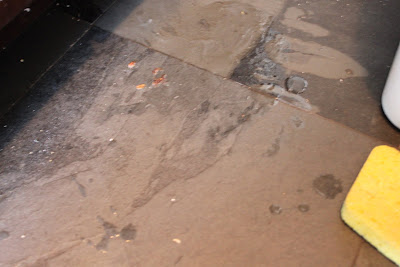
When the floor had been cleaned, the Queen added in 2 tablespoons of butter (because it seemed like the thing to do) and ran the food processor and the dough came together. It finally looked like dough. He checked the tagine. It was warming up, nothing hot yet, but it was getting there. She began to make small tablespoon sized balls and then flattening them into cookies. She placed several into the heated tagine. Only, about 10 minutes later, the cookies hadn’t done much. She decided that the double boiler idea wasn’t working too well. She placed the tagine directly on the flame and let it get hot. Unfortunately the Queen had been storing some dried rose petals in the tagine for the last several months and as it heated up, the thing stunk like dried roses.

*Sniff Sniff* Not 4 minutes later the Queen smelled that the cookies were burning. She uncovered the tagine and found THIS!! This flame was too hot. So she pitched this batch and washed out the tagine to remove most of the burned bits. She tried the tagine again on low. This time she watched the cookies more closely. After a little while she flipped the cookies. They were slightly burned, but still good.

But, she decided, this approach was not working. She decided to try a frying pan. Yes, a frying pan would give her more control, even heat, the whole nine. So she heated up a little coconut oil-just in case there wasn’t enough fat in the dough already. She placed in a few cookies and started frying them. This kind of worked! They browned. And if she kept the heat low the cookies could continue to cook and maybe look normal. She tasted one. The sugar still tasted pretty granular, and the whole thing was really went like a spoonful of peanut butter, rather than bready like a cookie. Oh well, not her finest kitchen moment, but edible nonetheless. She finished up the batch and set the cookies into the fridge to harden up as all the peanut oil, butter and now coconut oil had gotten very soft through the cooking process.
There are a couple of morals to this story. First off, Kings if you are just dying to spoil your princes and princesses with candy, can you do it less often, or choose items that don’t involve food dyes, like regular non candy-coated chocolate? Secondly, sucanat and rapadura are not the same thing as I might have alluded to on this site previously. They are very similar but sucanat seems more wet and chewy whereas rapadura or Rapunzel sugar is crunchy. Still, I look forward to experimenting with sucanat, as now I have a 2 pound bag of it in my cabinet. Thirdly, sugar burns. It actually burns a lot faster than say, onions and garlic. Not having pan fried that many cookies, the Queen wasn’t aware of this miracle. It took her a little off guard. Also, your family will still eat even marginal desserts because they contain delicious sugar, so don’t sweat a poor outcome. Your creation will not go to waste.
The last moral is really the best--Fact is usually better than fiction!

Orthomolecular Pioneer on Vitamin C

Should you decide to follow Dr Bate's advice you can buffer ascorbic acid with NAHCO3
The Best Vitamin
What's the best vitamin?  Of course as Linus Pauling and others before him found - it's Vitamin C.  But, there's a catch.  Because of the lies and distortions of the truth by Big Pharma, very few people get even close to what all primates (that's us and apes etc) really need for vitamin C.Did you know that the RDA (Recommended Daily Allowance) was originally set up only to PREVENT deficiency diseases?  Did you know that it was named MDA (MINIMUM Daily Allowance), and the change to RDA was promoted by both Big Pharma and Big Food.  Of course, Big Food simply wanted to be able to advertise and sell food as better than it was for profit.  And there is a lot of food promoted that is negative nutrition because of the sugar and crap in it - but it has FDA approval.The motive for Big Pharma was quite different.  If the true "values" of Vitamin C were known to the public, they would lose billions of sales.  So, Big Pharma has hired "tame" MD's to do so-called "scientific testing' that has shown vitamin C to be not effective against colds and flu viruses, let alone cancer etc.)  Vitamin C has proven over and over that it can cure cancers mediated by viruses.65 million years ago, the "primates" (including our ape ancestors) somehow lost one very important enzyme that is necessary to make the chemical change from glucose (blood sugar) into Vitamin C.  Virtually all other animals on the planet have this enzyme, and they manufacture their own Vitamin C to fight infection, both bacterial and viral.  Why do you suppose that meat eaters (our pet cats and dogs up to and including buzzards) can eat diseased meat unharmed?  They make their own Vitamin C as needed - we can't.So, what is a "REAL" RDA amount for daily health?  Go to a zoo, and talk to the primate vet, and you'll find that a 150 ape needs 4000mg daily. (Apes are more valuable than humans it would seem.  How can  75mg compare to 4000mg)?   That RDA is actually what we need as well, but Big Pharma controlling the Food and Drug Administration keeps it at 75 mg.  The sicker you are, the more drugs they sell, and the more profit.  It's as simple as that from the profit standpoint. But, since all other animals make their own "as needed", and this amount varies as the situation varies, so a 150 lb dog might make 5 grams of vitamin C in one day, and only 2 the next day.   Just what does Vitamin C do in the body IF (That's what's known as a BIG F) you get enough? 
  1.  It kills bacteria and virus cells much better than any antibiotic even invented.  And, it has no bad side effects like killing off the "good" bacteria in the gut, and ruining good digestive tract health.  
  2.  The ascorbic acid (same as made by other animals and cheapest of all forms) combines with all minerals in the blood, and takes them out of the body.  This includes all the toxic minerals such as mercury, lead, copper, etc. (The ascorbate forms (more expensive and sold as "pH neutral" do not do this very valuable work.   This works like expensive chelation and used correctly, vitamin C takes the calcium out of the plaque in the blood arteries and veins.  Since the calcium plaque is what holds the fatty acids into the arteries, then the fatty acids,(including cholesterol) melt away, and the multi-billion industry of "statins" loses a lot of bucks. Other animals have no cholesterol problems because of this.
By keeping this info secret, or by ridiculing it with phony tests, Big Pharma protects its profits - so a few people die - "so what" seems to be their attitude.   
 3. Since toxic minerals really put stress on the brain and body, the level of overall body stress is lowered, and this is critical to health.
The real problem is getting enough.  If you get a bacterial or viral infection, Vitamin C is used up very fast.  And, because both "germs" double in size every 20 minutes, it's going to take one hell of a lot to get ahead of it. 
Say you take 2000mg, and say that that kills one half of the "germs".  (If you start taking it early.) 20 minutes later, you're back to original size, and by the end of an hour, the number of "germs" is double to 4 times as when you started.  (Binary arithmetic is very fast to grow!)
Want a very efficient way to stop a cold or flu?  At the first sign of such, start taking 4000mg (4 grams) every 15 minutes.  Do this until you just start diarrhea,  (That's called "Bowel tolerance", and shows that you are getting at least a bit more than needed to solve the problem.)  Now cut back to 1000 mg per hour to be sure that the infection is "cured".  That's what I do, and I get rid of any symptoms within an hour or so.
So, I take 4000mg of Vitamin C daily, split into two doses, and if I cut myself, I put nothing on the cut, and let it scab over and never get infected.  I horrify MD's and Nurses by using insulin needles up to 10 shots to myself, and I don't even use alcohol.   
Now, there are many different forms of Vitamin C on the market, so how can you tell which is best for you?
The two different types are plain (cheap) ascorbic acid Vitamin C, (usually with a few bioflavinoids in it).  The second type is already mixed with some mineral such as Calcium Ascorbate, or Sodium Ascorbate.  These forms do NOT take out minerals, and therefore aren't as good (to me) as the plain and cheapest ones.  The plain  ascorbic acid is what all other animals make in their own body out of glucose.
(With all the sugar in our diet today, if we could get that enzyme back, we'd all live much better and longer.)
Do yourself a favor and go with the cheapest, as it's the best, and the most natural.  


Top posts from Natural Health News (from more than 30)


Jan 04, 2011
From ANH - The FDA has just notified small pharmacies that they will no longer be allowed to manufacture or distribute injectable vitamin C—despite its remarkable power to heal conditions that conventional medicine can't touch. ...
Sep 27, 2006
Other help for these glands are vitamin C and bee pollen. These glands are the 'fight or flight' center of your body and are often exhausted in stress. Alfalfa and spirulina may also be good to use for general support. ...
Feb 02, 2011
A 16-year study on the relationship between Vitamin C consumption and heart disease in women shows that Vitamin C supplement users reduce the risk of of non-fatal heart attacks and fatal heart disease by 28%, compared with non-users. ...
Jul 24, 2009
Vitamin C Facts. UPDATE: July 28 - Here is some additional information that may be useful to you regarding the flu propaganda. Additional vitamin C is helpful for your animal companions as well. I recently cured myself and my wife using ...

Water Pollution: Compound slows growth of nitrate-reducing bacteria

More reasons to use high quality probiOtics and the best water filter
Antibiotic Pollution May Increase Groundwater Nitrate
Charlie Schmidt
SIDE EFFECTS Antibiotics, such as sulfamethoxazole, could kill beneficial bacteria that clean up groundwater.
Decades after spawning a health care revolution, antibiotics are now common pollutants. Scientists' biggest concern about these emerging contaminants is that they promote the spread of resistance. But new research suggests they also harm the microbes that cleanse groundwater of dangerous compounds, particularly nitrates (Environ. Sci. Technol., DOI: 10.1021/es103605e).
High nitrate levels in drinking water can cause methemoglobinemia, a disease that decreases the blood's oxygen carrying capacity. Naturally-occurring bacteria in groundwater, such as Pseudomonas putida, can remove nitrates by reducing them to nitrogen gas.In Cape Cod, Mass., very high nitrate levels co-occur in groundwater with one of the most common antibiotics in the clinical arsenal: sulfamethoxazole (SMX). For nearly a decade, microbiologist Ronald Harvey and colleagues from the U.S. Geological Survey have tracked SMX and other groundwater pollutants at an aquifer that originates at the Otis Air National Guard Base, a heavily polluted site on Cape Cod. Other researchers had shown that high doses of SMX can interfere with bacterial nitrate reduction. But no one knew if a similar response might occur at environmentally-relevant concentrations.
To answer that question, Harvey's team first cultured bacteria from a non-contaminated portion of the aquifer. Next, they added nitrate to the cultures at levels measured in the environment, along with SMX at doses ranging from 0.005 to 2,000 µM. Bacterial growth rates dropped at all doses. At the environmentally relevant concentration of 0.005 µM SMX, the amount of total nitrate that the bacteria removed from the culture fell by nearly half. "We're demonstrating a clear biological effect," Harvey says. "And we're showing that in the same bacteria that live in this particular aquifer."
Harvey says that the next step would be to study the bacteria's response to SMX exposure in the aquifer itself.
USGS research hydrologist Dana Kolpin, who didn't participate in this study, thinks the results suggest that SMX contamination might account at least in part for high nitrate levels in the aquifer. "We can't jump to that conclusion yet," he says. "But the data suggest that's a hypothesis worth pursuing."
Chemical & Engineering News
ISSN 0009-2347
Copyright © 2011 American Chemical Society
http://pubs.acs.org/cen/news/89/i12/8912scene4.html


20 Maret 2011

Native Pollinators

Most people don't relish the thought of inviting more bees into their garden, but pollinators play an important role in our ecosystems. I've just finished reading a new book called "Attracting Native Pollinators: Protecting North America's Bees and Butterflies".

Silphium connatum
Photo courtesy of Mary Tucker


Many folks know that pollinators are more than just bees and butterflies.  Pollinators include wasps, flies, beetles, even birds and bats.  Bees, however, are the best pollinators thanks to unique physical characteristics and nutritional needs.  Recent news stories about Colony Collapse Disorder have made even more people aware of how honey bees are used around the country to pollinate food crops through the transportation of hives in large trucks (timed to arrive as crops enter their flowering phase).  Honey bees, however, are not native bees.  There are hundreds of species of native bees that do a far better job of pollinating flowers than honey bees.  We need to support them.

Non-native honey bee approaches Quince flower


This book's goal is to educate folks on how to both attract and support native bees.  The concepts provided, however, apply also to attracting and supporting non-native bees and other insect pollinators.  The book includes an overview of each type of insect pollinator, including how effective they are in pollination (and why) and what living arrangements support them.  Understanding these details is important to any efforts we make to support them.

Dandelion

Of course it is important to understand why pollination is important, not just for food crops but all plants.  While some plants are capable of self-fertilization, many more need help with pollination or they can have a greater rate of fertilization and produce more vigorous offspring when cross-pollination occurs.  Plants that are endangered or which have reduced populations are especially sensitive to pollination problems: reduced pollination rates means fewer viable seeds and that ultimately affects the size of the population.  Even for plants that can self-pollinate, reductions in cross-pollination means less genetic diversity in the population as a whole.  While wind can help distribute some lighter weight pollens, it is insects that provide most of the "outcross" pollen that plants receive.

Bees: there are three things to understand about native bees - they can be solitary or social, they can nest in the ground or in a cavity, and that they are usually generalists when it comes to the plants from which they gather nectar and pollen.  Most people think of honey bee hives when they think of bee "living arrangements", but more than 90% of the 4,000 species of bees in North America lead solitary lives; this means that each female builds and stocks her own nest without any help.  Bumble bees are the best known native bees that live in a social arrangement.  In this arrangement, each bee has a specific job to do.  Of all the insect pollinators, bees are the most important group for two reasons: bees visit flowers specifically to gather nectar and pollen as food for their young and in doing so transfer large amounts of pollen to other flowers; bees are physically capable of transporting more pollen because of their individual body hairs and other pollen transportation features (we've all seen those big pollen globs on their legs, right?).

Wasps: it was fascinating to learn more about wasps.  Wasps, unlike bees, are carnivores during the larval stage, feeding on insect prey provided by their mothers.  Adult wasps visit flowers only to sip nectar for themselves, and most do not collect pollen on purpose; any pollen collected is by accident.  Pollination is largely incidental as a result their search for nectar (they also sup on soda and other sugary sources, remember?) and far less effective than pollination by bees.

Flies: as the largest group of insects (nearly 120,000 species worldwide), flies represent a significant portion of the insects that visit flowers.  However, like wasps, flies are only visiting flowers to grab some quick energy (nectar), and pollination is usually a by-product.  There are some flies that mimic the look of bees and wasps to elude those that would eat them.  Once way to distinguish a fly from a bee is to look at the number of wings: flies have two wings and bees have four. Flies are good pollinators for some food crops like strawberries and carrots; muscid flies have been commercially raised for carrot pollination purposes.

Butterflies and Moths: I think this statement from the book perfectly describes our relationship with these pollinators: "Although butterflies are not the most important pollinators of plants, they are among the most conspicuous."  Like wasps and flies, butterflies go to flowers only to sip nectar and therefore any pollination is only accomplished if they happen to pick up some pollen on their wings and spread it to the next flower.  I found an interesting tidbit on distinguishing butterflies from moths in this book: butterflies have a small bulbous tip at the end of their antennae.  Moths do not have this bulb.

Beetles: it is estimated that beetles predate bees by 50 million years (according to fossil records); therefore, beetles have been pollinating the earliest flowers (think Magnolia-like flowers) for a long time.  And if you thought there were a lot of flies, consider that there are 340,000 species of beetles worldwide!  Not all beetles visit flowers, and like the other insects except for bees, the purpose of their visit is only to nourish the adult.  In the case of beetles, it is to eat pollen, not sip nectar.

So now that we know we have all these pollinators, how can we help them?  In some cases, the answer is to be a bit more laissez-faire - leave the leaves on the ground to nourish ground dwelling critters like adult beetles and those that consume those creatures like wasps.  Leave dead tree snags and branches for wood burrowing insects like beetles and solitary bees. Brush piles and rocks help as well.  Leave some bare ground for ground-dwelling bees and wasps, and create special mason houses for bees that prefer those.

Plum (Prunus sp.)

Stokesia laevis with Asclepias tuberosa
Photo courtesy of Mike Strickland


You can have fun too; here is the fun part:  plant appropriate plants.  Here is a report on a project partially funded by the Georgia Native Plant Society; the project was a two-year study using Stokesia laevis to attract native pollinators.  When choosing plants: in general, you want to choose regionally appropriate and native plants that are long blooming, have overlapping bloom times, and have nectar-rich flowers.  Also plant butterly-host plants (including woody trees and shrubs) to sustain the larvae of butterflies and moths.  There are plenty of resources on the web about butterfly host plants for your area.  If you want to see the top 20 list of host plants for the mid-Atlantic area (both woody and herbaceous), check out this list provided by Doug Tallamy.

Helianthus sp.
Viburnum nudum var. cassinoides


This book is very helpful in understanding the importance of pollinators and how they live in the world around us.  I learned a lot and certainly plan to implement some changes in my garden to help these guys.  This book is published by The Xerces Society and is available on Amazon.  It includes 34 pages of identification pictures for native bees.  The reference section on pollinator plants is a bit skimpy - one would need to do more research to come up with more regional choices.  In general, look for pollen and nectar-rich flowers like the Helianthus and Viburnum pictured above.


These are unopened flower buds on my blueberry bushes (Vaccinium sp.).  The bees were circling them in the bright sunshine yesterday.  There was no doubt they knew that the buds would be open soon and were anxious to be there when it happened.  How wonderful that we help each other at the same time - they get what they need and I get more blueberries!

LinkWithin

Related Posts Plugin for WordPress, Blogger...