Tampilkan postingan dengan label Homemade. Tampilkan semua postingan

14 September 2011

How To Make Gripe Water

Gripe water is a natural remedy devised in the mid-1850s in England for easing the pains and discomfort of a baby troubled by colic, gas, cramping, indigestion, hiccups and teething. Variations of this recipe existed for centuries prior to its marketing as "gripe water." The original recipe contained alcohol, dill, fennel, sodium bicarbonate and sugar. However, because of ethical issues of giving babies alcohol and the harmful affects of sodium bicarbonate on young children, most people prefer to use a more "modern baby" friendly recipe. You CAN purchase Gripe Water at most baby or drug stores, however if you're worried about quality or ingredients, it's best to make your own, and when it's this easy, why not?

Below you'll find a collection of recipes, choose the one you like best and give it a try. Some of these contain things like sugar or corn syrup, if you don't wish for your child to have such ingredients, choose a different recipe or simply skip that step. However, for young children sugar or corn syrup can be used to help combat the bitter taste. Remember, when you make your own, you can adjust amounts to fit your needs!


Gripe Water Recipe #1

  1. Add 1 tsp Caraway, Fennel or Dill seed to 1Pt Water
  2. Bring to boil & Simmer about 10 mins uncovered
  3. Cool to Room Temp
  4. Serve

Gripe Water Recipe #2
  1. Place 1 teaspoon of fennel seeds in a plastic bag and seal it.
  2. Beat the seeds. Use your hammer to beat the fennel seeds in the bag thoroughly. Now you have crushed fennel seeds.
  3. Pour 2 pints of water into a pan and place it on the stove on high heat.
  4. Boil the crushed fennel and 1 teaspoon of dill seeds for 15 minutes.
  5. Take the pan off the stove and strain out the mixture.
  6. Pour the resulting fluid in a bottle.
  7. Allow to cool to room temperature (use refrigerator for faster cool time - but serve room temp)
  8. Feed it to the baby. Shake the solution and offer up to 1/2 teaspoon whenever it suffers from digestion-related problems.

Gripe Water Recipe #3
  1. Measure one tsp. whole fennel seeds and place in a small mixing bowl. (fresh fennel can be used)
  2. Add 1/4 tsp. chopped fresh ginger to the fennel in the mixing bowl. (ground ginger can be used)
  3. Add 1/4 tsp. chopped fresh dill to the bowl along with two fresh leaves of mint that have each been torn in half. (Dried dill and mint can be used)
  4. Mix the herbs together with a mixing spoon, crushing the fennel seeds. 
  5. Pour the herbs into a small saucepan.
  6. Cover the herbs with four cups of water 
  7. Add one tbsp. of corn syrup. (optional)
  8. Bring the combination to a boil. Cover and reduce heat. Allow to simmer for 20 minutes.
  9. Pour over a strainer
  10. Cool to room temperature

Gripe Water Recipe #4
  1. Measure out 1 or 2 tbsp. ea Crushed Fennel seeds, dill seeds, chamomile & ginger. Peppermint, Lemon Balm and Cinnamon Bark can also be added if you choose.
  2. Place all ingredients in pot along with 3 cups water.
  3. Bring the water to a boil and let it boil for two minutes.
  4. Turn the heat down to a simmer and let the gripe water simmer for 10 to 20 minutes.
  5. Strain herbs from water
  6. Add honey or sugar to sweeten the water if you like.
  7. Cool to room temperature.
Gripe Water Recipe #5
*You will need a tea ball or cheese cloth/muslin for this method, but you can simply boil & strain if you wish as well.
  1. Grind, process or crush 1tsp fennel seed, 2tsp Chamomile, 1/2 tst Peppermint, 2 tsp Ginger
  2. Place ground mixture in tea-ball (or use cheese cloth or muslin to make a bag)
  3. Place ball in 3c water & boil on high for 2 minutes.
  4. Simmer 15-20 mins
  5. Remove from heat & remove ball.
  6. Stir in 2-3 tsp sugar
  7. Coot to room temp

Notes for ALL Gripe Water - 
  • Always serve at room temperature! 
  • Store in tightly sealed container.
  • Discard unused Gripe Water after 24-48 hours.
  • Give in doses of 5-10 ml up to 6 times a day.
  • Cheese cloth is useful for straining small particles of ground herbs or seeds

13 Juni 2011

Recipe for Homemade Whey

Makes about 5 cups.

Homemade whey is easy to make from good quality plain yoghurt, or from raw or cultured milk. You will need a large strainer that rests over a bowl.

If you are using yoghurt, place 2 quarts in a strainer lined with a tea towel set over a bowl. Cover with a plate and leave at room temperature overnight. The whey will drip out into the bowl. Place whey in clean glass jars and store in the refrigerator.

If you are using raw or cultured milk, place 2 quarts of the milk in a glass container and leave at room temperature for 2-4 days until the milk separates into curds and whey. Pour into the strainer lined with a tea towel set over a bowl and cover with a plate. Leave at room temperature overnight. The whey will drip out into the bowl. Store in clean glass jars in the refrigerator.

Source: Nourishing Traditions by Sally Fallon with Mary G. Enig, PhD.

Make your own Baby Formula

Sure, breast is best, but it's not always an option. If you're on medication or have breast issues, supply issues, infections, surgery or of course if your child is adopted, breast-milk may simply not be an option. If you read the labels or do some research on Formula Ingredients and what they are, I'm sure you would be SHOCKED! This stuff is supposed to be healthy for babies, but in reality it's far far from it.

Now, if you MUST use formula, but you don't want to use all the artificial, chemical laced baby formulas from the shelf, what do you do? Well, you make your own! Here are SOME recipes for home made formulas, I'm sure I will be adding to this list, and if you look hard enough you can find more. But these will at least give you somewhere to start.

I do want to point out, before we get in to the actual recipes, that as with ANY new or different diet change you need to make sure you are using high quality ingredients and that you both research each option and make a point to watch your child for ANY reaction. I suggest you start them on a new formula on a day when you will be with them ALL DAY, and make a point to watch them for at least 3 days for reactions. Now, I say do this with ALL formulas, whether home made or not.

NOTE - All of these formulas are simply mix and serve or mix and store... So I'm not listing instructions on each one. 

Goats Milk Formula
  •  13oz liquid Goat Milk
  • 19 oz distilled or spring water
  • 2TB sugar

Goats Milk II
  • 2 Cups - Goats Milk
  • 2 Cups - Enriched Vanilla Rice Dream
  • 1 T. - Black Strap Molasses
  • 1 T. - Liquid Acidophilus
  • 1 T. - Flax Seed Oil
  • 1 t. - Liquid Vitamin C
  • 1 t. - Liquid CalMag (calcium & magnesium)
  • 1/8 t. - Wheat Germ (powdered )
  • 16 drops - Trace Minerals (concentrated) 

Goats Milk III
  • 4 oz Goats Milk
  • 2 oz Carrot Juice
  • 2 oz Water
  • a few drops Flax Oil (EFAs) with DHA
  • 1/4tsp nutritional yeast {for the folic acid and b12 boost that goats milk lacks}

Goat's Milk IV
  • 2 cups water(highest quality)
  • 2 cups goat milk
  • 2 cups hemp nut seed milk
  • 1/4 cup goat whey
  • 1 tablespoon colostrum
  • 4 tablespoon lactose
  • 2 teaspoon nutritional yeast
  • 1/4 teaspoon camu berry powder
  • 1 capsule of aged garlic
  • 1 teaspoon of infant probiotics
  • 1 tablespoon of lecithin
  • 1 tablespoon of coconut oil
  • 1 teaspoon of cod liver oil
  • 1 teaspoon of flax seed oil

Raw Cows Milk
  • 2 cups whole raw milk
  • 1 7/8 cups filtered water 
  • 1/4 cup homemade liquid whey
  • 2 or more tablespoons good quality cream (not ultra-pasteurized)
  • 2 teaspoons coconut oil
  • 1/2 teaspoon high-vitamin cod liver oil
  • 1 teaspoon expeller-expressed sunflower oil
  • 1 teaspoon extra virgin olive oil
Dry Formula Mix
This recipe's ingredients are very specific and can be found at either:
Natren 866-462-8736, or Radiant Life 888-593-8333

  • 4 tablespoons lactose powder
  • 2 teaspoons nutritional yeast flakes
  • 2 teaspoons gelatin
  • 1/4 teaspoon Natren bifidobacterium infantis
  • 1/4 teaspoon acerola powder

For ALL Formula:
Warm with hot water from the tap, or place glass bottle with goat milk in a pan full of water and gently heat. Test on inside of your arm before feeding to baby. Milk should be warm, not hot. DO NOT MICROWAVE!!!

Give baby only enough that they will drink and refrigerate, or freeze the rest. Do not reuse any milk left over from baby bottle after baby has finished drinking.

Unused milk will stay fresh for 3-5 days in refrigerator.

To freeze, separate unused goat milk into equal parts and store individually in freezer. Frozen breast-milk or goat milk stays fresh between 3 to 6 months in freezer.


**If you will be using formula as a supplement, in addition to breast-milk, don't worry about additives.
***If this will be your babies only source of food, you MUST add liquid infant vitamins to the child's diet, do not add it to the formula. Each brand will have it's own dosage, make sure to follow the dosage according to the package. Your pediatrician may be able to give you an idea of what brand is best!

16 Mei 2011

Laundry Soap Recipes

There are most likely just as many home made laundry soap recipes as there are store bought ones. But here are SOME of the ones I have encountered... Making your own laundry soap will not only save you money, but will allow you to control the ingredients and their quality.

Just as each family will have their own needs and preferences when it comes to store bought soaps, you'll encounter that for home made too. I suggest if you see a recipe you like, make a small batch and see what you think if you are nervous about trying something new. But since most ingredients are either already in your home or are very inexpensive to buy, even if you decide to make a large batch and don't like it, you really aren't loosing much!

OPTIONAL: If you prefer to have a "prettier" smell or if you would like more of an antibacterial or anti-grease property to your laundry soap, you can add Essential Oils. Tea Tree Oil has great antibacterial properties. Sweet Orange is wonderful for grease. And there are a myriad of options for fragrance. 10-15 drops per 2 gallons

Liquid Laundry Soap

Recipe #1

You will need:
  • 1 quart Water (boiling)

  • 2 cups Bar soap (grated)

  • 2 cups Borax

  • 2 cups Washing Soda

*Add finely grated bar soap to the boiling water and stir until soap is melted. You can keep on low heat until soap is melted.
*Pour the soap water into a large, clean pail and add the Borax and Washing Soda. Stir well until all is dissolved.
*Add 2 gallons of water, stir until well mixed.
*Cover pail and use 1/4 cup for each load of laundry. Stir the soap each time you use it (will gel).

Recipe #2

You will need:
  • Hot water

  • 1 cup Washing Soda

  • 1/2 cup Borax

  • 1 Soap bar

*Grate the bar soap and add to a large saucepan with hot water. Stir over medium-low heat until soap dissolves and is melted.
*Fill a 10 gallon pail half full of hot water. Add the melted soap, Borax and Washing soda, stir well until all powder is dissolved. Top the pail up with more hot water.
*Use 1 cup per load, stirring soap before each use (will gel).

Recipe #3

You will need:
  • Hot water

  • 1/2 cup Washing Soda

  • 1/2 cup Borax

  • 1/3 bar Soap (grated)


*In a large pot, heat 3 pints of water. Add the grated bar soap and stir until melted. Then add the washing soda and borax. Stir until powder is dissolved, then remove from heat.
*In a 2 gallon clean pail, pour 1 quart of hot water and add the heated soap mixture. Top pail with cold water and stir well.
*Use 1/2 cup per load, stirring soap before each use (will gel).

Recipe #4

You will need:
  • Hot water

  • 1 bar (4.5 oz) Ivory Soap - grated

  • 1 cup Washing Soda

*In a large saucepan add grated soap and enough hot water to cover. Heat over medium-low heat and stir until soap is melted.
*Fill a large pail with 2.5 gallons of hot water, add hot soap mixture. Stir until well mixed.
*Then add the washing soda, again stirring until well mixed.
*Set aside to cool.
*Use 1/2 cup per full load, stirring well before each use (will gel)

Recipe #5

You will need:
  • 2.5 gallons Water (hot)

  • 1 Bar soap (grated)

  • 3/4 cup Washing Soda

  • 3/4 cup Borax

  • 2 TBS Glycerin

*Melt bar soap over medium-low heat topped with water, stir until soap is melted.
*In a large pail, pour 2.5 gallons of hot water, add melted soap mixture, washing soda, borax and glycerin. Mix well.
*Use 1/2 cup per full load.

Recipe #6

You will need:
  • 2 cups Bar soap (grated)

  • 2 cups Washing Soda

  • 2 - 2.5 gallons hot water

*Melt grated soap in saucepan with water to cover. Heat over medium-low heat and stir until soap is dissolved.
*Pour hot water in large pail, add hot soap and washing soda. Stir very well.
*Use 1 cup per full load.

Recipe #7


You will need:
  • 2 gallons Water (hot)

  • 1 bar Soap (grated)

  • 2 cups Baking soda (yes baking soda this time–not washing soda)

*Melt grated soap in a saucepan with enough hot water to cover. Cook on medium-low heat, stirring frequently until soap is melted.
*In a large pail, pour 2 gallons hot water. Add melted soap, stir well.
*Then add the baking soda, stir well again.
*Use 1/2 cup per full load, 1 cup per very soiled load.

Recipe #8
DR. BRONNER'S HOMEMADE LAUNDRY SOAP

You will need:
  • 1 cup Dr. Bronner's pure castile liquid soap

  • 1 cup baking soda

  • 2 cups water

  • 1/3 cup salt


*Warm the water and mix with salt and baking soda until dissolved.
*Pour into a one-gallon container.
*Add the Dr. Bronner's and fill the remainder of the gallon jar with water.
*Use 1/4 cup of laundry soap per load.
*This laundry soap doesn't create suds, but it doesn't need to in order to get your laundry clean.


Powdered Laundry Soap

Recipe #1

You will need:
  • 12 cups Borax

  • 8 cups Baking Soda

  • 8 cups Washing Soda

  • 8 cups Bar soap (grated)

*Mix all ingredients well and store in a sealed tub.
*Use 1/8 cup of powder per full load.

Recipe #2

You will need:
  • 2 cups Fels Naptha Soap (finely grated)

  • 1 cup Washing Soda

  • 1 cup Borax

*Mix well and store in an airtight plastic container.
*Use 2 tablespoons per full load.

TIPS
  • Use Milk Jugs or Old Laundry Soap Jugs for liquid/gel soaps

  • Gallon sized "Food containers" are great for powdered soap storage

  • Remember to check the ingredients of any soap used, some of them are less than healthy choices! I prefer Castile Soaps but there are many options out there.

  • Use a food processor or blender to grate or powder bars of soap quickly and easily.


**More to come! Post yours as a comment & I'll add it!

5 Juni 2010

How to Make Yogurt at Home


So I bought all this extra milk from the farmer's market last weekend because I bought that cheese making kit a couple of weeks ago. I had meant to make the cheese over the holiday weekend. But we ended up going away, and wasted a lot of the time we were at home by loafing around. And it's too busy during the week to make cheese in the evening. I also really wanted Thing 1 to be able to help, and of course during the week I am at work except during the high tension times of getting ready for work and the evening screamfests we call dinner.
I really wanted to blog about making the cheese this week too! I even told the nice lady at the milk stand that the cheese post would be up mid week. I guess that was a good way of derailing my plans!

But another project came along. Our babysitter, knowing of our blog project, said she could teach me how to make yogurt.

Wait.

What?

Don't you need special equipment to make yogurt, like a little heater and a bunch of little cups and a timer or a thermometer? Surely I needed something with an electrical plug. I was so curious. So, she told me how to do it.

How to make yogurt at home (and I swear it works)
What you'll need:
* A very clean pot with a lid, like a dutch oven A couple of clean cotton dish towels
* A half gallon of milk, I used 2% organic low temperature pastuerization milk. I don't know if you need the low temp pasteurization for yogurt, but I know you need it for cheese, so it can't hurt. I know you can also use whole and it makes a richer yogurt.
* 5 tablespoons of already made yogurt. Look for L. Bulgaricus on the container if you can.
* Cheesecloth or really thin towel (we had an old burp cloth that was really thin) (did I mention that everything was really clean?)

So yeah, it's kind of a gyp that you need to buy yogurt to make yogurt, but hey, once you do you'll never have to buy yogurt again! And by the way, all you busy working parents: start this around 6pm and by the time you wake up the next morning, you'll have yogurt.
So pour the milk into the very clean dutch oven and bring the milk up to a low boil. I used milk from my dear dairy in Ghent, NY that I buy from, Milk Thistle. They are a certified organic farm making milk and the most ridiculous cream from grass fed cows. They sell at the farmer's markets here in New York City and I have also seen their milk at the Whole Foods in Union Square. Check out their website here. Turn the milk off and let it cool to the point that it is warm, but not hot. So let it cool for 20 minutes or so. You don't want the milk so hot that it kills the yogurt bacteria.

Next take a little warm milk and add it to your 5 tablespoons of yogurt and get that nice and thin. Add the thinned down yogurt one tablespoon at a time into the milk, stirring it in thoroughly in between each tablespoon. When all the yogurt is incorporated into the warm milk, place a clean cloth over the pot and place the lid on top of it. And though I am not sure why I was instructed to do so, place another cloth around the dutch oven, like you would do to a child who's just gotten out of the bath.
Then, let it sit on the counter for 10-12 hours.
That's right. I said let a container of milk sit on the counter for 10-12 hours.

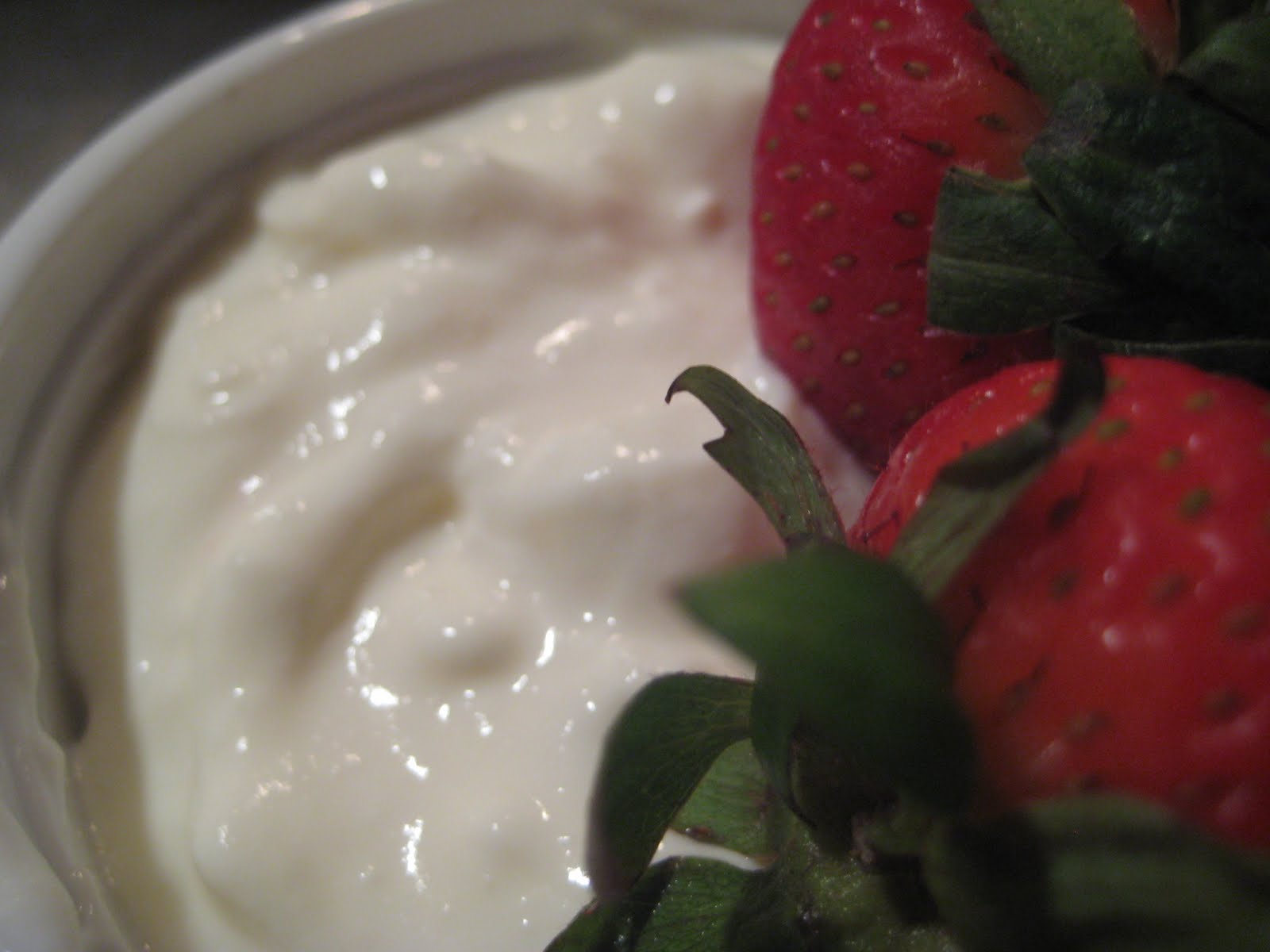
Well, I did all of the above and low and behold, when I woke up the next morning I had a big pot of yogurt. I half expected to open the dutch oven and have the milk smell sour and foul. But much to my amazement, it smelled sweet and yogurty! Our babysitter helped us do one more step, she took the yogurt and wrapped it in an old thin burp cloth that is just a little thicker than cheesecloth. She let the yogurt strain in the cloth pouch for a few hours and it became as thick as greek yogurt. You could use a heavier cloth to strain it and really get all the water out and you would have a delicious spread that resembles cream cheese.

A half gallon of yogurt made what looks like more than a quart of fresh yogurt once we got it down to the thick greek stage. It was pretty sour, so if you like it less tart, only let it sit on the counter for 6-8 hours and maybe let it remain thin rather than strain it, since taking the more of the water out will only serve to concentrate the flavors. We like it sour, so we are happy. It would even be a good replacement for sour cream, which we hardly ever buy anymore because I have just been using yogurt.

I am so psyched to demystify something as complex as yogurt. In our culture today, we have been taught to be afraid of germs, and that the only safe way to prepare delicate food items is in a sterilized industrial kitchen setting. But my yogurt is far more delicious than any I have bought. I know where the cows that made that milk live (the address is on the jug), I know what they ate. To be honest, I pay a hefty fee for my milk, $7 a half gallon. Which makes my organic yogurt more expensive than the one I usually buy. But it is slightly less than a container of greek style yogurt, which is not organic. But I pay the extra because I love this milk. I love the people who make it and sell it to me. And it is the most delicious milk in the world. It's quality is unparalleled. It has a value to me far and above the $7 that I paid for it. Now I know that not everyone can afford $14 a gallon milk, and to be sure I cut back in other ways to afford it because it's important to me. But there are some great local options and some great affordable organic options out there and I bet if you dig around on the internet you can find some in your area too.

Post script:
We ate the yogurt. It was good and no one got sick. Try it, you just might like it.

LinkWithin

Related Posts Plugin for WordPress, Blogger...