So what is the big deal between kefir and yogurt? Is it just that one is more liquid-y than the other?
I have known about kefir for some time. I have seen it in the grocery store and I have heard about people who drank it. I knew that kefir wasn’t just drinkable yogurt, but I admit, I wasn’t sure why it wasn’t just drinkable yogurt. So what is the difference between kefir, regular yogurt and Greek yogurt?
For the sake of this post I am just sharing some insight about the PLAIN varieties of all three products. It is true, most of the regular yogurt on the marketplace is sold inclusive of fruit, lots of sugar and in many case high-fructose corn syrup or even worse, aspartame. It (she laughs) wouldn’t be fair of me to compare only lightly pasteurized kefir to ultra pasteurized yogurt with HFCS. And I like fairness. So here are some things to keep in mind.
· Kefir and yogurt are both fermented milk products. That is, milk that has been partially ‘eaten’ by bacteria. These bacteria are both specific strains (not just any airborne bacteria will do) and beneficial to your gut.
· Yogurt usually contains one or two strains of bacteria like acidophilus and bulgaricus. These strains are common in Eastern Europe and the Caucuses. Something that our Bulgarian babysitter loves to proudly remind us of…often.
· Kefir contains up to 13 strains of different bacteria. According to kefir.net, those strains can include “Lactobacillus Caucasus, Leuconostoc, Acetobacter species, and Streptococcus species.”
· Also according to kefir.net, “Yogurt contains transient beneficial bacteria that keep the digestive system clean and provide food for the friendly bacteria that reside there. But kefir can actually colonize the intestinal tract, a feat that yogurt cannot match.” This was the information I was looking for on the internet….thank you.
· In case you didn’t read that last one: According to kefir.net, “Yogurt contains transient beneficial bacteria that keep the digestive system clean and provide food for the friendly bacteria that reside there. But kefir can actually colonize the intestinal tract, a feat that yogurt cannot match.” That is pretty much the most important point in this post.
· The beneficial bacterium that is found in kefir and yogurt is found in the whey. Greek yogurt is plain yogurt that has been strained of much of its whey. This is why Greek yogurt is higher in protein (and calories) per ounce than its unstrained sister. Most of what remains are the milk solids. Greek yogurt is also lower in probiotic activity because it has had most of the whey removed. I love Greek yogurt because its taste is rich and thick and fatty. It is less tart and very pleasing. But I am not delusional; the greater probiotic choice is plain yogurt and definitely kefir.
The health claims of kefir beyond what I have mentioned above are long long long. It apparently helps everything from ADD to cancer to fighting Candida. And while I am not disputing that here, I remind everyone that kefir, like every other food and drug on the market, will likely work differently in different bodies. The taste is pleasing and the digestive benefits have been proven. And I love how filling it is. Whatever other positive benefits you reap are awesome, but conclusive of all 78 items on this list from the link I posted? I am just not sure. I don’t like posting anything here that I claim to be a wonder drug/ food. However that being said, I definitely have better digestion and by that I mean that my husband is less able to poke fun at me after a Mexican dinner.
I am truly in LOVE with my kefir. Go to http://www.kefirlady.com/ if you are curious. She has lots of great information, instructions and recipes. And she has been a pleasure to deal with!
This post is part of Traditional Tuesdays at Real Food Whole Health and Simple Lives Thursday at GNOWFLINS and Sustainable Eats and Fight Back Fridays at Food Renegade
Tampilkan postingan dengan label yogurt. Tampilkan semua postingan
Tampilkan postingan dengan label yogurt. Tampilkan semua postingan
24 Mei 2011


1 Maret 2011
Chocolate Cherry Ice Pops

It's true. I am pining for the summer. I look out the windows of my east facing apartment and I see the chimneys puffing steam in the distance. The snow has melted and every week or so we are treated with a 45 degree day like last weekend. Those are the days when it is easy to forget that we still have 3 more weeks of winter. Sorry Punxatony Phil, it doesn't matter what you said this year (I really am not sure what you said at all this year, actually), winter will continue until the vernal equinox of March 20th. But now that I am typing it out, 3 weeks sounds doable. So in honor of warmer times to come, I broke out the cheapy popsicle maker I bought at target years ago and made something I knew the kids would revel in, Chocolate Cherry Popsicles. I made the popsicles entirely from eyesight, just adding in what I liked and what tasted good. I am trying here to approximate the amounts, but don't look at this as a super tested recipe. Just more like guidelines....
Chocolate Cherry Ice Pops
1/2 cup of regular whole milk yogurt
1/2 cup full fat greek yogurt
1/2 teaspoon of vanilla
1/4 cup of cherry juice (100% juice, no sweeteners, use something else if you can't get this)
2 teaspoons of cocoa powder
honey to taste
Place all ingredients into your blender, or I used the cup that came with my immersion blender. Blend and pour into popsicle maker. Freeze.
I bought cherry juice because I was looking for organic pomegranate juice at the grocery store. 100% organic pomegranate juice was $10 a bottle (yipes!!). And I only wanted it to make flavored kombucha. I thought $10 was too expensive, so the same brand offered organic cherry juice, not from concentrate with no additional ingredients. It was $6. Still pricey, but a better compromise. But instead of just serving up the leftover 3/4 of a bottle, as I am not a fan of juice, I thought there were some interesting things I could do with it. The cocoa powder is super high in antioxidants like bioflavinols, and by adding it I can tell my kids that the popsicles are chocolate. So there you go. Something I don't have to feel guilty about. And I can still manage to do some spoiling.
Chocolate Cherry Ice Pops
1/2 cup of regular whole milk yogurt
1/2 cup full fat greek yogurt
1/2 teaspoon of vanilla
1/4 cup of cherry juice (100% juice, no sweeteners, use something else if you can't get this)
2 teaspoons of cocoa powder
honey to taste
Place all ingredients into your blender, or I used the cup that came with my immersion blender. Blend and pour into popsicle maker. Freeze.
I bought cherry juice because I was looking for organic pomegranate juice at the grocery store. 100% organic pomegranate juice was $10 a bottle (yipes!!). And I only wanted it to make flavored kombucha. I thought $10 was too expensive, so the same brand offered organic cherry juice, not from concentrate with no additional ingredients. It was $6. Still pricey, but a better compromise. But instead of just serving up the leftover 3/4 of a bottle, as I am not a fan of juice, I thought there were some interesting things I could do with it. The cocoa powder is super high in antioxidants like bioflavinols, and by adding it I can tell my kids that the popsicles are chocolate. So there you go. Something I don't have to feel guilty about. And I can still manage to do some spoiling.
30 Desember 2010
More Food Folly
While Dr OZ is pushing turkey bacon, you might want to know why I chose uncured pig bacon instead, along with REAL yoghurt.
And for the (fake) yogurt eaters, here's a new take on what we have been saying for decades -
TURKEY BACON
Pork bacon’s got a bad rap for wreaking havoc on your cholesterol. But is turkey bacon really any better?
The Truth: Stick with the pig. As far as calories go, the difference between “healthy” turkey bacon and “fatty” pig is negligible—and depending on the slice, turkey might sometimes tip the scales a touch more. Additionally, while turkey is indeed a leaner meat, turkey bacon isn’t made from 100 percent bird: One look at the ingredients list will show a long line of suspicious additives and extras that can’t possibly add anything of nutritional value. And finally, the sodium content of the turkey bacon is actually higher than what you’ll find in the kind that oinks—so if you’re worried about your blood pressure, opting for the original version is usually the smarter move.
Eat This Instead: Regular bacon. We like Hormel Black Label and Oscar Mayer Center Cut bacon for some low-cal, low-additive options.
And for the (fake) yogurt eaters, here's a new take on what we have been saying for decades -
FRUIT ON THE BOTTOM YOGURTAdding the benefits of berries? New in 2011: Our "simply4health Daily Fruit" and our High ORAC value Aronia berry capsules. Goji can be ordered directly, see "Rich Nature Super Fruits" in the right column.
It seems like the ideal breakfast or snack for a man or woman on the go—a perfect combination of yogurt and antioxidant-packed fruits, pulled together in one convenient little cup. But are these low-calorie dairy aisle staples really so good for you?
The Truth: While the yogurt itself offers stomach-soothing live cultures and a decent serving of protein, the sugar content of these seemingly healthy products is sky-high. The fruit itself is swimming in thick syrup—so much of it, in fact, that high-fructose corn syrup (and other such sweeteners) often shows up on the ingredients list well before the fruit itself. And these low-quality refined carbohydrates are the last thing you want for breakfast—Australian researchers found that people whose diets were high in carbohydrates had lower metabolisms than those who ate proportionally more protein. Not to mention, spikes in your blood sugar can wreck your short-term memory, according to a study in the European Journal of Clinical Nutrition. Not what you need just before your urgent 9 a.m. meeting with the boss!
Eat This Instead: Plain Greek-style yogurt, mixed with real blueberries. They’re jacked with about 15 to 22 grams of belly-filling protein, so they’ll help you feel satisfied for longer. And blueberries are another great morning add—scientists in New Zealand found that when they fed blueberries to mice, the rodents ate 9 percent less at their next meal.
tips from Eat This, Not That!, by David Zinczenko.
5 Juni 2010
How to Make Yogurt at Home
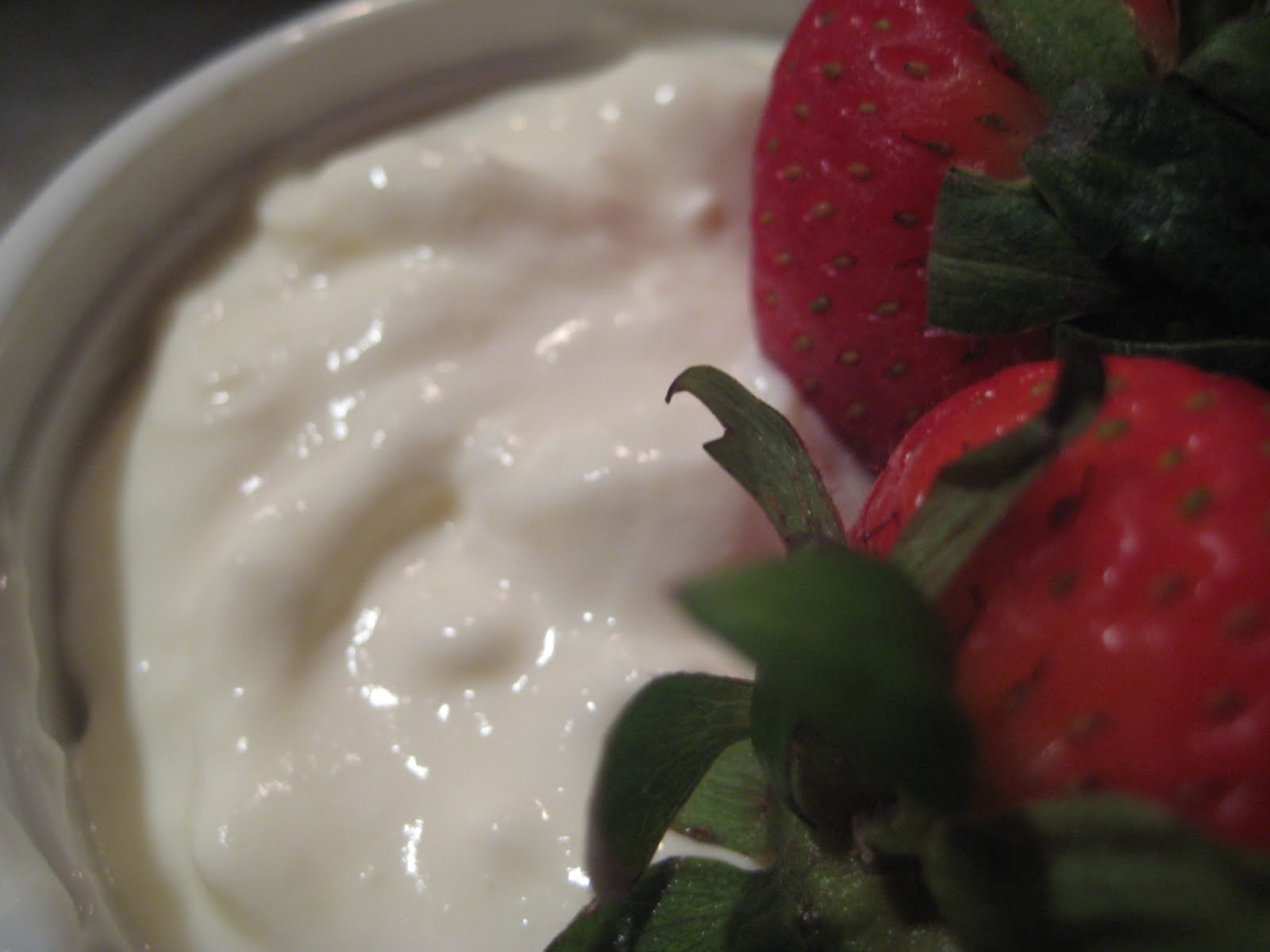
So I bought all this extra milk from the farmer's market last weekend because I bought that cheese making kit a couple of weeks ago. I had meant to make the cheese over the holiday weekend. But we ended up going away, and wasted a lot of the time we were at home by loafing around. And it's too busy during the week to make cheese in the evening. I also really wanted Thing 1 to be able to help, and of course during the week I am at work except during the high tension times of getting ready for work and the evening screamfests we call dinner.
I really wanted to blog about making the cheese this week too! I even told the nice lady at the milk stand that the cheese post would be up mid week. I guess that was a good way of derailing my plans!
I really wanted to blog about making the cheese this week too! I even told the nice lady at the milk stand that the cheese post would be up mid week. I guess that was a good way of derailing my plans!
But another project came along. Our babysitter, knowing of our blog project, said she could teach me how to make yogurt.
Wait.
What?
Don't you need special equipment to make yogurt, like a little heater and a bunch of little cups and a timer or a thermometer? Surely I needed something with an electrical plug. I was so curious. So, she told me how to do it.
How to make yogurt at home (and I swear it works)
What you'll need:
* A very clean pot with a lid, like a dutch oven A couple of clean cotton dish towels
* A very clean pot with a lid, like a dutch oven A couple of clean cotton dish towels
* A half gallon of milk, I used 2% organic low temperature pastuerization milk. I don't know if you need the low temp pasteurization for yogurt, but I know you need it for cheese, so it can't hurt. I know you can also use whole and it makes a richer yogurt.
* 5 tablespoons of already made yogurt. Look for L. Bulgaricus on the container if you can.
* Cheesecloth or really thin towel (we had an old burp cloth that was really thin) (did I mention that everything was really clean?)
So yeah, it's kind of a gyp that you need to buy yogurt to make yogurt, but hey, once you do you'll never have to buy yogurt again! And by the way, all you busy working parents: start this around 6pm and by the time you wake up the next morning, you'll have yogurt.
So pour the milk into the very clean dutch oven and bring the milk up to a low boil. I used milk from my dear dairy in Ghent, NY that I buy from, Milk Thistle. They are a certified organic farm making milk and the most ridiculous cream from grass fed cows. They sell at the farmer's markets here in New York City and I have also seen their milk at the Whole Foods in Union Square. Check out their website here. Turn the milk off and let it cool to the point that it is warm, but not hot. So let it cool for 20 minutes or so. You don't want the milk so hot that it kills the yogurt bacteria.
* 5 tablespoons of already made yogurt. Look for L. Bulgaricus on the container if you can.
* Cheesecloth or really thin towel (we had an old burp cloth that was really thin) (did I mention that everything was really clean?)
So yeah, it's kind of a gyp that you need to buy yogurt to make yogurt, but hey, once you do you'll never have to buy yogurt again! And by the way, all you busy working parents: start this around 6pm and by the time you wake up the next morning, you'll have yogurt.
So pour the milk into the very clean dutch oven and bring the milk up to a low boil. I used milk from my dear dairy in Ghent, NY that I buy from, Milk Thistle. They are a certified organic farm making milk and the most ridiculous cream from grass fed cows. They sell at the farmer's markets here in New York City and I have also seen their milk at the Whole Foods in Union Square. Check out their website here. Turn the milk off and let it cool to the point that it is warm, but not hot. So let it cool for 20 minutes or so. You don't want the milk so hot that it kills the yogurt bacteria.
Next take a little warm milk and add it to your 5 tablespoons of yogurt and get that nice and thin. Add the thinned down yogurt one tablespoon at a time into the milk, stirring it in thoroughly in between each tablespoon. When all the yogurt is incorporated into the warm milk, place a clean cloth over the pot and place the lid on top of it. And though I am not sure why I was instructed to do so, place another cloth around the dutch oven, like you would do to a child who's just gotten out of the bath.
Then, let it sit on the counter for 10-12 hours.
That's right. I said let a container of milk sit on the counter for 10-12 hours.
Well, I did all of the above and low and behold, when I woke up the next morning I had a big pot of yogurt. I half expected to open the dutch oven and have the milk smell sour and foul. But much to my amazement, it smelled sweet and yogurty! Our babysitter helped us do one more step, she took the yogurt and wrapped it in an old thin burp cloth that is just a little thicker than cheesecloth. She let the yogurt strain in the cloth pouch for a few hours and it became as thick as greek yogurt. You could use a heavier cloth to strain it and really get all the water out and you would have a delicious spread that resembles cream cheese.
A half gallon of yogurt made what looks like more than a quart of fresh yogurt once we got it down to the thick greek stage. It was pretty sour, so if you like it less tart, only let it sit on the counter for 6-8 hours and maybe let it remain thin rather than strain it, since taking the more of the water out will only serve to concentrate the flavors. We like it sour, so we are happy. It would even be a good replacement for sour cream, which we hardly ever buy anymore because I have just been using yogurt.
I am so psyched to demystify something as complex as yogurt. In our culture today, we have been taught to be afraid of germs, and that the only safe way to prepare delicate food items is in a sterilized industrial kitchen setting. But my yogurt is far more delicious than any I have bought. I know where the cows that made that milk live (the address is on the jug), I know what they ate. To be honest, I pay a hefty fee for my milk, $7 a half gallon. Which makes my organic yogurt more expensive than the one I usually buy. But it is slightly less than a container of greek style yogurt, which is not organic. But I pay the extra because I love this milk. I love the people who make it and sell it to me. And it is the most delicious milk in the world. It's quality is unparalleled. It has a value to me far and above the $7 that I paid for it. Now I know that not everyone can afford $14 a gallon milk, and to be sure I cut back in other ways to afford it because it's important to me. But there are some great local options and some great affordable organic options out there and I bet if you dig around on the internet you can find some in your area too.
Post script:
We ate the yogurt. It was good and no one got sick. Try it, you just might like it.
Langganan:
Postingan (Atom)
LinkWithin
